
Here, we will discuss a pilot’s income in Quebec, based on data collected in 2022.
It is important to note that the information provided here is not exhaustive. This article is primarily intended to offer a simplified and general overview of a pilot’s salary progression.
It should be noted that the situations and career paths described do not necessarily reflect those of all pilots, but they generally closely resemble the paths taken by the majority of them.
The scarcity of public information regarding a helicopter pilot’s salary stems from the variability in how this compensation is calculated. The factors that influence a pilot’s salary can be numerous and varied, making it difficult to obtain an accurate picture of their compensation.
Generally speaking, a pilot's salary consists of three components:
A flight hour bonus
For every hour of flight time logged, the pilot earns an hourly bonus.
The more they fly, the more they earn.
The more complex the mission, the higher the hourly bonus.
To ensure a steady income, it is not uncommon for pilots to be guaranteed a minimum number of paid flight hours per day, regardless of whether those hours are actually flown.
A fixed hourly wage
For all ground-based tasks, such as helicopter preparation, client management, and all administrative duties.
The more experienced the pilot, the higher their base salary, as they take on more responsibilities within the company.
Any other applicable premiums
These allowances vary depending on the assignment, and there is one for every unusual situation:remote location allowance, on-call allowance, daily allowance for room and board, fire hazard allowance, etc.
Why does a pilot's salary increase exponentially over the course of their career?
For a pilot, experience is measured by the number of flight hours.
The more flight hours a pilot has, the more competent and experienced they are considered to be.
They will have access to a wider variety of assignments, as well as positions with greater responsibilities.
With experience, a pilot’s flight hour bonus and base salary both increase.
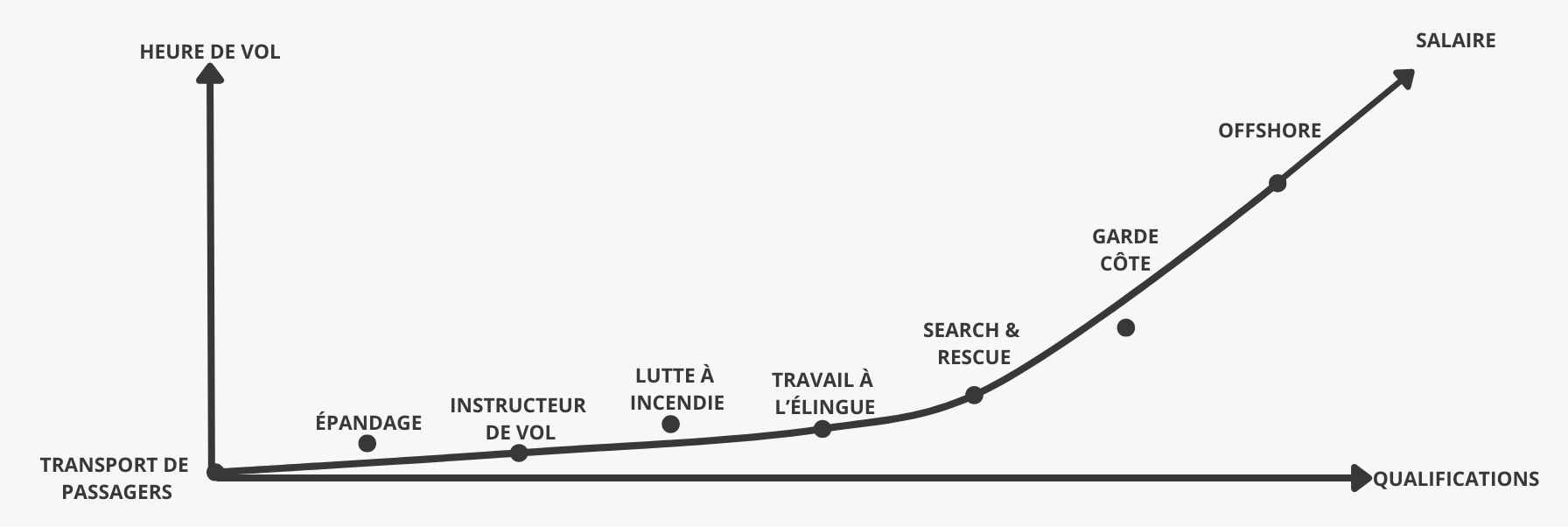
Here is a chart that visually illustrates how salary increases correlate with acquired qualifications and the number of flight hours accumulated.
How much does a helicopter pilot earn?
In this section, we will take a detailed look at the various factors that have a significant impact on a helicopter pilot’s compensation. It is also important to note that a pilot can only be compensated for flight hours if they hold a commercial pilot’s license.
From 100 to 500 flight hours
This level begins at 100 hours, as that is the minimum number of flight hours required to obtain the commercial pilot license, which allows a pilot to be paid for their work.
Early in their career, due to a lack of experience and skills, young pilots fly infrequently.
They are not capable of performing all types of missions; they only fly simple flights.
He earns few flight bonuses, and his base salary is minimal because he has few responsibilities. On average, he earns between $30,000 and $45,000 and flies between 30 and 150 hours per year.
From 500 to 1,500 flight hours
Reaching the 500-hour flight milestone is a significant milestone in a pilot’s career. At this point, they have more experience, greater responsibilities, and access to a wider range of missions (such as firefighting and flight instruction). As a result, they fly more frequently. They earn between $50,000 and $85,000 per year.
Why such a difference in annual income?
The intensity of forest fires and the number of additional missions influence the number of flight hours and, consequently, compensation.
A pilot does not necessarily have the same income year after year.
After 1,500 flight hours
The pilot is considered experienced. So, his career could take several different paths:
- Specialized Pilot: They now have access to specific missions, which they may or may not choose to pursue.
For example, a pilot who specializes in precision sling operations or search and rescue will develop rare and highly sought-after skills. - Administrative role: With their experience, they may be able to advance to managerial positions that are primarily office-based, such as Chief Pilot or Director of Operations…
In both cases, their pay increases as they take on more responsibilities: their base salary and flight-hour bonus are adjusted.
At this stage in their careers, pilots generally earn $85,000 or more: there is no cap on their compensation, and it is determined on a case-by-case basis.
Conclusion
Early in their career, young pilots should take advantage of easy flight opportunities to develop their skills so they can later take on more complex, higher-paying assignments.
Once they’ve reached certain milestones, pilots can choose their assignments and negotiate the pay they want.
Discover the training programs offered by Helicraft that will enable you to become a helicopter pilot.

Roche Sebastian
FLIGHT INSTRUCTOR - MARKETING MANAGER